- Sharjah, United Arab Emirates
- CALL ANYTIME : +971 6 534 5585
- info@aim-insu.com
Industrial floors in the UAE operate under some of the most demanding conditions. Extreme heat, heavy machinery, forklift traffic, chemical exposure, and strict hygiene requirements place continuous stress on concrete surfaces. Many floor failures occur not because of poor materials, but because the wrong coating system is selected for the environment.
For this reason, engineers carefully evaluate flooring systems before specifying them for warehouses, factories, logistics facilities, and food processing plants. Two of the most widely used solutions are epoxy flooring and polyurethane (PU) flooring. Both systems protect concrete surfaces, but they perform differently depending on temperature exposure, mechanical loads, and environmental conditions.
Understanding the strengths of each system helps contractors, engineers, and facility managers select a flooring solution that delivers durability, safety, and long-term performance.
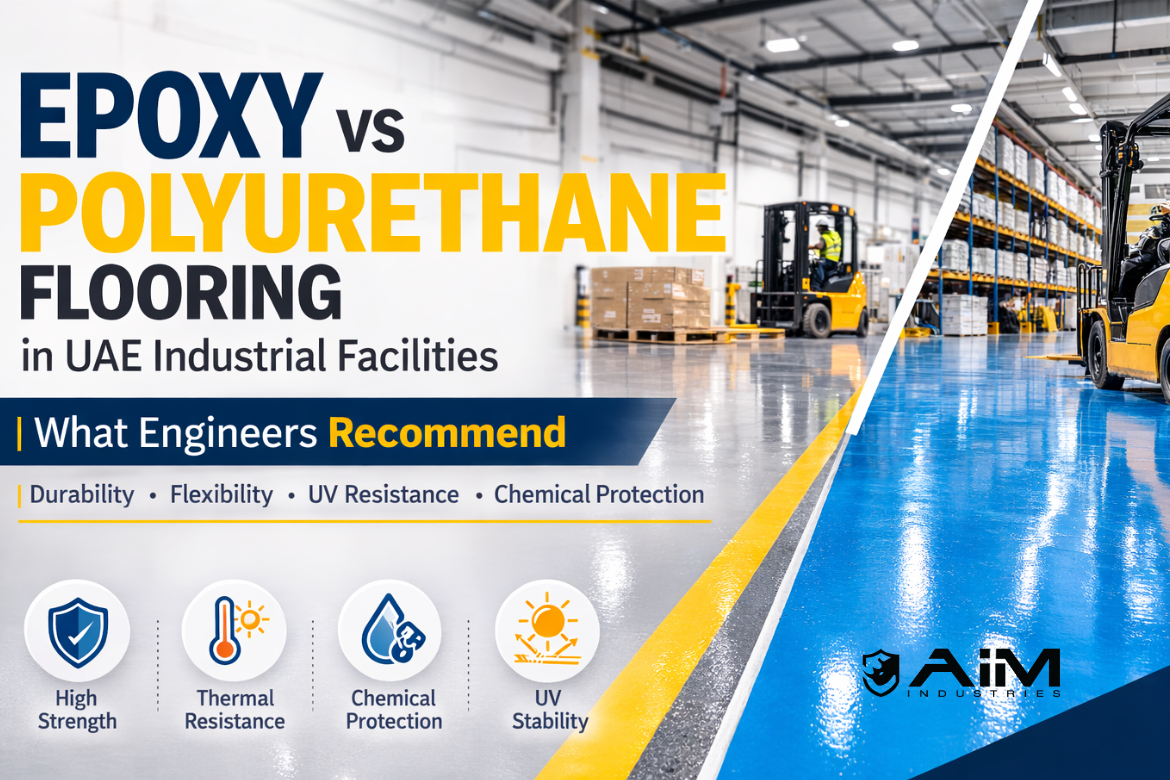
Concrete floors in industrial buildings experience constant mechanical and environmental stress. Without proper protection, concrete surfaces may develop cracks, surface dusting, chemical damage, or abrasion caused by heavy equipment.
Protective floor coatings help improve:
Selecting the correct system is essential because different industrial environments demand different performance characteristics.
Epoxy flooring is a resin-based coating that forms a dense, durable layer over concrete. Once cured, the material bonds tightly to the substrate and creates a seamless protective surface capable of handling heavy loads and constant traffic.
Because of its hardness and cost efficiency, epoxy flooring is widely used in indoor industrial facilities where mechanical strength is the main requirement.
A commonly used system in industrial flooring projects is ADVAPOXY 1500, a solvent free epoxy coating designed to provide strong adhesion and long term protection for concrete surfaces.
Key technical characteristics include:
Because of its structural performance, coatings such as ADVAPOXY 1500 are typically used in environments where floors experience continuous forklift movement, pallet handling, and mechanical loading.
Another system used in heavy duty flooring applications is ADVAPOXY 2000, which provides thicker protection and enhanced durability for industrial surfaces.
Typical characteristics include:
These types of epoxy systems are widely applied in warehouses, manufacturing facilities, and logistics centers where impact resistance and structural floor protection are critical.
Polyurethane flooring systems are designed for environments where temperature fluctuations, sunlight exposure, or aggressive cleaning processes can affect rigid coatings.
Unlike epoxy, polyurethane materials have higher elasticity. This allows them to expand and contract with temperature changes without cracking.
One commonly specified polyurethane coating is ADVATHANE 2K, a two component aliphatic polyurethane coating designed to deliver durable and UV stable protection.
Key technical characteristics include:
Because of these properties, ADVATHANE 2K is often used as a protective layer in areas exposed to sunlight or environmental wear.
Another polyurethane solution used in industrial applications is ADVATHANE 2k Clear, which provides a transparent yet durable protective finish while maintaining UV stability.
Typical performance characteristics include:
Polyurethane coatings such as these are commonly used in parking structures, loading bays, and industrial environments exposed to sunlight or temperature changes.
Although both systems Gprotect industrial floors, engineers select them based on how they respond to environmental conditions and operational loads.
| Feature | Epoxy Flooring | Polyurethane Flooring |
|---|---|---|
| Best Environment | Indoor industrial areas | Outdoor or temperature sensitive areas |
| Flexibility | Rigid | Highly flexible |
| UV Resistance | Limited | Excellent |
| Thermal Shock Resistance | Lower | Very high |
| Impact Resistance | High | Very high |
| Cost | Generally lower | Higher |
This comparison explains why epoxy coatings are commonly used for structural durability indoors, while polyurethane coatings perform better in environmentally exposed areas.
When specifying flooring systems for industrial projects, engineers evaluate several important performance factors.
These include:
By analyzing these factors, engineers can determine whether epoxy, polyurethane, or a combination of both systems will provide the most reliable performance.
Warehouses experience constant forklift traffic and pallet movement. Engineers usually recommend epoxy flooring systems because they provide high compressive strength and can handle heavy industrial loads.
Food production facilities often involve hot water cleaning and exposure to organic acids from dairy or food products. In these environments, polyurethane flooring systems are often preferred because they provide better resistance to thermal shock and cleaning chemicals.
Cold storage and freezer rooms experience rapid temperature changes during defrosting cycles. Polyurethane coatings perform better in these conditions because they remain flexible at low temperatures and resist cracking.
Areas exposed to sunlight require coatings with strong UV stability. Polyurethane flooring is commonly recommended because it resists yellowing and surface degradation caused by UV exposure.
Facilities exposed to oils, solvents, or industrial chemicals often use epoxy coatings due to their excellent resistance to chemical attack and mechanical wear.
Instead of choosing only one material, many industrial projects in the UAE use hybrid flooring systems to maximize performance.
This approach combines the strengths of both epoxy and polyurethane coatings.
The first layer is usually an epoxy coating applied directly to the prepared concrete surface. This layer provides:
A polyurethane topcoat is then applied over the epoxy layer to provide:
This combination allows facilities to benefit from epoxy’s structural strength and polyurethane’s environmental resilience.
Industrial flooring performance depends not only on the coating type but also on the quality and consistency of the materials used.
In the UAE construction sector, engineers often prefer working with manufacturers that provide reliable formulations, technical documentation, and materials designed for regional climate conditions.
AIM Industries, a UAE based manufacturer of waterproofing, insulation materials, and construction chemicals, develops industrial coatings and related systems that are designed to perform under Gulf climate conditions.
The company focuses on producing materials that support contractors and engineers in delivering durable construction solutions.
Professionals in the industry often value manufacturers that provide:
These factors help engineers and contractors ensure that flooring systems perform reliably across demanding industrial environments.
Selecting the right system depends largely on operational conditions.
Epoxy flooring is often preferred when
Polyurethane flooring is usually recommended when
In many cases, combining both systems can provide the most balanced solution.
In the UAE’s demanding industrial environment, selecting the right flooring system is an important engineering decision rather than just a finishing choice. Epoxy flooring offers excellent strength, durability, and chemical resistance for indoor industrial facilities, while polyurethane flooring provides flexibility and UV resistance for areas exposed to temperature changes or sunlight.
By evaluating operational requirements and environmental conditions, engineers can determine whether epoxy, polyurethane, or a hybrid system will deliver the best performance. When the correct system is specified and installed properly, industrial facilities can significantly extend the life of their concrete floors while reducing maintenance and operational disruptions.

AIM INDUSTRIES is a premier manufacturer of waterproofing, insulation, and allied chemical solutions, offering high-quality building materials for project needs. In 2005, AIM INDUSTRIES joined the Al Sindbad group family, which has been a trusted name in the industry since its establishment in 1990.
Consultation